Cloud Migration Dependencies in Canada: AWS, Azure or GCP
Choose the platform after you understand what the workload depends on. Map these ten dependency domains before a production cutover—not while users are waiting for service to return.
The short answer
AWS, Azure and Google Cloud can all support serious Canadian workloads. The safer choice is the platform whose regional services, identity model, network design, operating controls and commercial terms fit your verified requirements. Provider selection does not remove dependency discovery.
Working aid only. Answers stay in your browser and are not submitted.
Get the 30-Dependency Cloud Migration Worksheet
Seven printable pages with owner, evidence and gap fields for every dependency domain, plus a go, conditional-go or no-go decision record.
- Use it in discovery and cutover-readiness sessions.
- Keep the evidence links and decision owners together.
- No newsletter signup is required.
Choose from the workload outward
A useful provider decision begins with the business outcome and the current system. What must remain available? Which components communicate synchronously? Where are identities issued? How quickly does data change? Which team will operate the target at 2 a.m.? The answers narrow the architecture more reliably than a generic feature matrix.
Existing skills and contracts matter, but they are not the whole decision. Validate service availability in the intended Canadian region, the hybrid network path, platform and third-party licensing, backup and recovery options, monitoring, support, egress and the cost of running source and target together during transition.
The traffic path is part of the workload
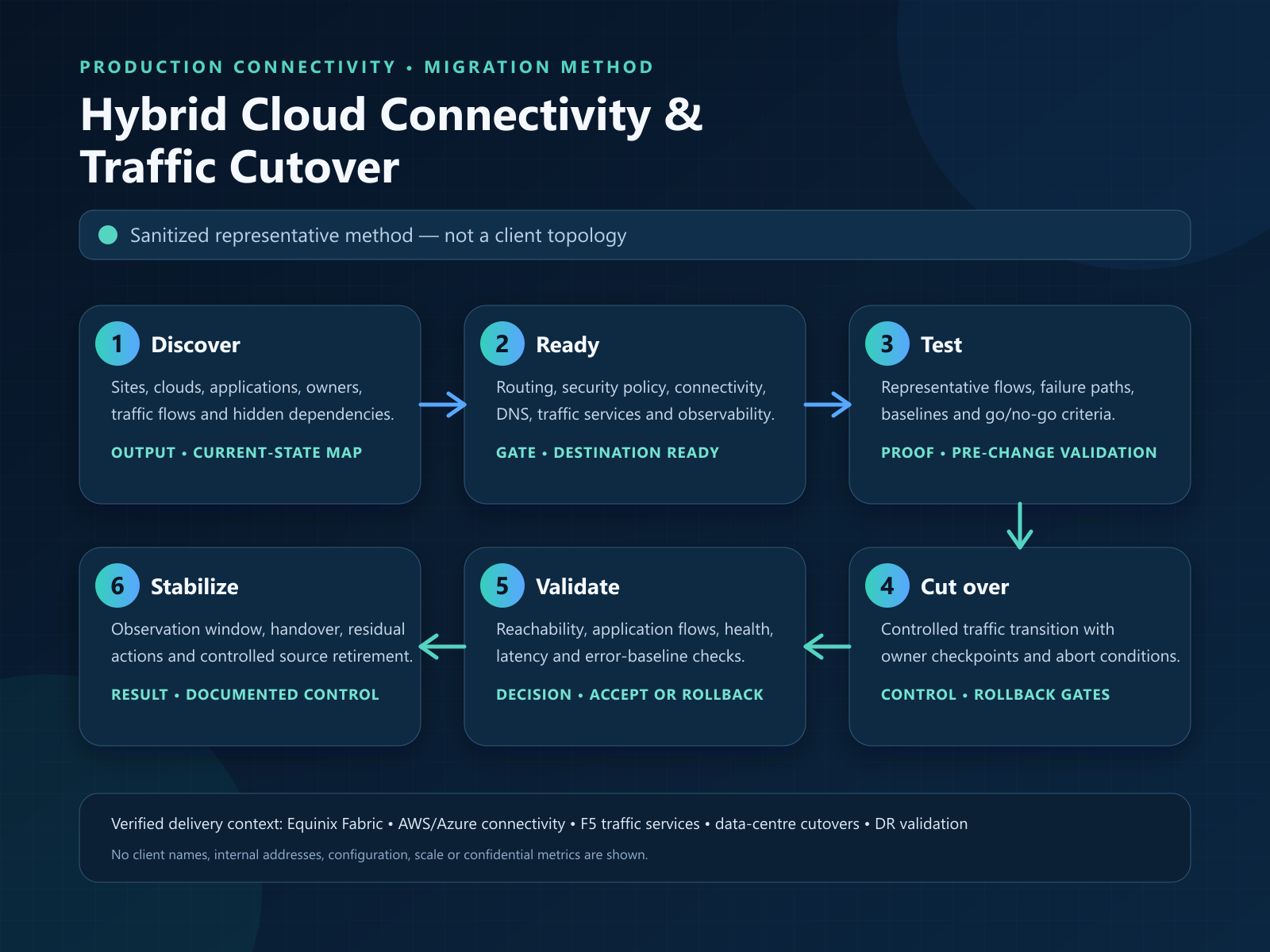
This sanitized method view shows why cloud migration planning must include sites, routing, security policy, private connectivity, DNS and the traffic switch alongside the application. It is a representative Layer7 method—not a client topology or a design for every environment.
Workload boundary and decision ownership
Can the team name the whole service—not only the servers selected for migration?
A workload includes the users, business process, data, integrations and operating responsibilities around the infrastructure. If those boundaries are unclear, the target design and cutover window are guesses.
Evidence checklist
A one-page scope, owner matrix and measurable success criteria.
Cloud foundation and policy inheritance
Is the destination a governed operating environment or simply a new account?
Account hierarchy, subscriptions or projects, identity boundaries, policy, logging, billing and break-glass access affect every workload placed in the cloud. Fixing them during cutover expands risk at the worst time.
Evidence checklist
An approved target-foundation diagram plus access, policy and quota test results.
Human and workload identity
What still authenticates through the source environment after the move?
User sign-in is only one identity path. Applications also depend on service accounts, managed identities, federation, secrets, certificates, directory lookups and automated credentials.
Evidence checklist
An identity-flow diagram, least-privilege role map and tested access record.
Network, hybrid connectivity and egress
Can every required path reach the target with the right route, latency and security treatment?
A migration can succeed inside the cloud console while users, branches, partners or source systems cannot reach it. Return paths, overlapping address space, NAT, inspection and egress are frequent hidden dependencies.
Evidence checklist
A current flow matrix, routing diagram and results from target-path tests.
DNS, TLS and traffic services
Which control actually moves production traffic, and what else must change with it?
The traffic switch may involve public and private DNS, load balancers, CDN or proxy configuration, certificates, health checks, web-application firewalls and third-party allowlists—not one DNS record.
Evidence checklist
A traffic-switch plan with owners, TTL evidence, certificate tests and reversal steps.
Data movement, synchronization and consistency
Can the team explain every write from the first copy through the final validation?
Files, databases, queues, object stores and caches do not become consistent at the same instant. The data method must match the volume, change rate, bandwidth and tolerated downtime.
Evidence checklist
Timed transfer tests, replication health and a signed reconciliation procedure.
Applications, integrations and licensing
What calls the workload only occasionally—and may not appear in a short discovery window?
Month-end jobs, vendor APIs, payment callbacks, SMTP, SFTP, webhooks, agents and license servers can be invisible during a quick scan. A successful homepage test does not exercise them.
Evidence checklist
An integration register with frequency, endpoint, owner, test and fallback.
Canadian data location and third-party handling
Do you know where every relevant copy, log, backup and support path can go?
Selecting a Canadian cloud region is an architecture input, not a complete privacy, contractual or regulatory conclusion. Service availability, replication, telemetry, support access and subprocessors can have different location characteristics.
Evidence checklist
A data-flow/location map, service-location evidence and recorded requirement owners.
Monitoring, backup, recovery and operating cost
Can the team detect failure, restore service and understand the new run cost?
A target can pass functional testing while lacking alerts, restore evidence, capacity headroom, cost controls or an operating team. Those are production dependencies, not post-migration cleanup.
Evidence checklist
Baseline/target dashboards, restore results, support ownership and a cost model.
Wave, cutover, rollback and acceptance
Has the dependency map been turned into an executable decision sequence?
Discovery has value only when it changes grouping, sequencing, test coverage or the go/no-go decision. A useful runbook defines expected results and the point after which returning becomes unsafe.
Evidence checklist
A rehearsed wave/cutover runbook, decision log and signed acceptance criteria.
The names change; the dependency questions remain
Use this as vocabulary for discovery, not as a product recommendation. The right combination depends on workload scale, existing architecture, availability, security, operating skill and the specific services offered in the selected region.
Swipe the table horizontally to compare all three platforms.
| Control area | AWS vocabulary | Azure vocabulary | Google Cloud vocabulary |
|---|---|---|---|
| Control hierarchy | Organizations and accounts | Tenant, management groups and subscriptions | Organization, folders and projects |
| Workload identity | IAM roles, Identity Center and workload roles | Microsoft Entra ID, RBAC and managed identities | Cloud Identity, IAM and service accounts/workload identity |
| Network foundation | VPC, Transit Gateway, Direct Connect or VPN | Virtual Network, Virtual WAN, ExpressRoute or VPN | VPC/Shared VPC, Cloud Interconnect or Cloud VPN |
| Traffic services | Route 53, Elastic Load Balancing and CloudFront | Azure DNS, Front Door, Application Gateway and Load Balancer | Cloud DNS and Cloud Load Balancing |
| Operations evidence | CloudWatch, CloudTrail and backup/recovery services | Azure Monitor, Activity Log and Azure Backup | Cloud Monitoring, Cloud Logging and Backup and DR |
| Canadian location check | Verify the selected service in Canada (Central) or Canada West (Calgary) | Verify service availability and resilience design for Canada Central/Canada East | Verify the selected service and resilience design in available Canadian regions |
A Canadian region is a starting condition, not the completed analysis
AWS, Microsoft Azure and Google Cloud publish Canadian location information, but service coverage and data-handling details vary. Map the actual services and flows, then have the accountable business, privacy, security, legal or sector owner confirm the requirements that apply to the workload.
- Which data must stay in a particular country, province, tenancy or contractual boundary—and who owns that interpretation?
- Where do replicas, backups, logs, security telemetry, support artifacts and temporary migration copies reside?
- Can the required database, security, backup, AI, analytics and networking services run in the chosen region?
- Which provider personnel, partners or subprocessors can access data, from which jurisdictions, and under what controls?
- What latency and failure-domain tradeoffs follow from the selected primary, recovery and hybrid locations?
- How will regional service pricing, currency, taxes, egress, private connectivity and overlap affect the approved cost model?
The minimum useful migration sequence
Keep tightly coupled components in the same dependency group or prove the split-environment path. Every wave needs target tests, a final-sync method, explicit go/no-go evidence, rollback treatment, business validation, stabilization and operational acceptance.
Readiness review or full migration project?
Start with a readiness review when
- The provider or target design is still uncertain.
- Dependencies, downtime, data movement or rollback contain assumptions.
- Several teams, sites, vendors or clouds must coordinate.
- You need a bounded written decision before approving implementation.
Request a project scope when
- The workload boundary and responsible owners are confirmed.
- The target, migration pattern and dependency groups are documented.
- Acceptance, downtime and rollback requirements are measurable.
- Required access, procurement, vendor and change windows are feasible.
Bring the source, intended destination, affected users, target window and what cannot break.
Layer7 turns the current environment and unresolved dependencies into a written current-state map, material gaps, target options, cutover and rollback requirements, and a defined next scope—even when the right recommendation is not to migrate yet.
Cloud migration questions to resolve before quoting cutover
Should we choose AWS, Azure or Google Cloud before doing dependency discovery?
You can shortlist a provider early, but do not finalize the target design from brand preference alone. Inventory the workload, identity, network, data, integration, regional, operational and contractual constraints first; then verify which platform and services fit them.
Does using a Canadian cloud region guarantee data residency or compliance?
No. A region is one input. Confirm the location behaviour of every selected service plus replicas, backups, logs, support access and subprocessors, then have the accountable owner validate the applicable contractual, privacy, regulatory and sector requirements.
What is the most commonly missed cloud migration dependency?
There is no universal single dependency. Identity, DNS, certificates, private routing, allowlists, scheduled jobs and data-write handling are frequent blind spots because they sit outside the visible application path or run only occasionally.
When should a business buy a migration readiness review instead of requesting a full-project quote?
Start with a readiness review when the workload boundary, dependencies, destination, downtime, data method, rollback or responsible teams are still uncertain. A full-project quote becomes more reliable after those uncertainties have owners and evidence.
Primary references
The control framework above is Layer7’s synthesis. The current primary sources below independently reinforce workload inventory, dependency grouping, target preparation, controlled cutover, rollback, validation and accountability for third-party processing.
- AWS Prescriptive Guidance — Wave planning and dependency groups
- AWS Prescriptive Guidance — Migration cutover overview
- Microsoft Cloud Adoption Framework — Document the cloud adoption plan
- Microsoft Cloud Adoption Framework — Plan an Azure migration
- Google Cloud Architecture Center — Assess and discover workloads
- Google Cloud Architecture Center — Validate a migration plan
- AWS — Global infrastructure and Canadian regions
- Microsoft Azure — Regions overview
- Google Cloud — Locations and region selection
- Office of the Privacy Commissioner of Canada — PIPEDA accountability principle
Sources reviewed and published September 14, 2026. Update the date only after substantive review.