Production migration and recovery
with a rollback path.
For live WordPress, Linux/VPS, application, cloud and hybrid environments that have to move, recover, or finally settle down — without guessing at what depends on what. CCIE Emeritus (#36102), 20+ years in production infrastructure, with AWS, Azure, GCP, hybrid-network, Linux/VPS, application, and WordPress experience.
The source, the destination if you know it, the deadline or incident state, and what cannot break — that is enough to start.
Two kinds of buyer, one operating promise
Understand the workload and its dependencies, prepare and test the destination, define go / no-go and rollback criteria, control the cutover, validate the service, and stabilize it afterward.
Businesses running live systems
Owners and operators responsible for a WordPress site, a Linux/VPS or Docker application, a cloud account, or a hybrid environment that has to move, recover, or stop misbehaving — and who need one senior engineer accountable for the whole change.
Independent MSPs and web agencies
Partners who own the client relationship and need behind-the-scenes migration, recovery, deployment or infrastructure escalation capacity, project by project.
How partner support worksMake the next decision with evidence
Untangle domain and hosting charges, work through six production-readiness gates, or map the dependencies that must move with an AWS, Azure or GCP workload.
Common starting points
None of these is an emergency by default. All of them go better when the dependencies are mapped before anything changes.
A live workload must move
A hosting change, cloud move, data-centre exit, platform migration, or modernization — and the site or application cannot simply go dark while it happens.
A deployment or migration is failing
The service is unstable, nobody is sure what depends on what, and the rollback path is incomplete or was never written down.
It works in the demo, not in production
The site or app runs on a laptop, a staging server or an AI app builder, but hosting, sign-in security, backups, monitoring or DNS still have gaps before real customers rely on it.
An agency or MSP needs escalation capacity
You own the client relationship, but this job needs deeper deployment, migration, Linux, WordPress or cloud depth than the team has spare right now.
Four kinds of production work
Different environments, one operating promise: understand the workload and its dependencies, prepare and test the destination, define go / no-go and rollback criteria, control the cutover, validate the service, and stabilize it afterward.
WordPress and hosting migration / recovery
Site and database moves between hosts, VPS or managed hosting, with the DNS, TLS and backup work that decides whether the move sticks.
- Site and database migration between hosts
- VPS and managed-host moves
- Backups, DNS and TLS handled as part of the move
- Recovery of a failed or half-finished migration
- Validation, stabilization, then hosting and maintenance if wanted
Linux / VPS and application deployment
Destination preparation and Docker or application deployment for database-backed workloads that have to run reliably from day one.
- Destination server and environment preparation
- Docker and application deployment
- Database and dependency handling
- Environment validation before traffic arrives
- Cutover and post-launch stabilization
Cloud and hybrid migration
AWS, Azure, GCP, on-premises and hybrid workload and connectivity moves, planned around the routing and security dependencies that usually get missed.
- Workload and connectivity planning across on-premises, AWS, Azure and GCP
- Readiness checks: routing, security policy, DNS, traffic services
- Migration and controlled traffic cutover
- Rollback gates agreed before the change
- Pre- and post-change validation
Production recovery and stabilization
Bounded diagnosis and a recovery plan for a service that is unstable, partially down, or was never properly finished.
- Bounded diagnosis of what changed and what depends on it
- Incident and recovery planning with checkpoints
- Configuration and dependency review
- Restoration support
- Observation window and handoff
Engagement types: assessment, diagnosis, scoped project, and managed care after delivery. Layer7 is a senior engineer working directly with you, not a 24/7 operations centre.
Six stages, with rollback at every one
This is a risk-control method, not a zero-downtime guarantee. It exists so the decision to continue or roll back is made deliberately, with the owner, at each checkpoint.
- 01
Discover
Workload, owners, dependencies, traffic, data, source and destination — and an explicit list of what cannot break.
Current-state map - 02
Ready
Destination, access, connectivity, security, DNS and load balancing, backups, monitoring, and rollback access in place before anything moves.
Destination ready - 03
Test
Representative traffic, data and application checks, baselines, failure paths, and the go / no-go criteria the owner signs off on.
Pre-change validation - 04
Cut over
A controlled transition with checkpoints and abort conditions agreed in advance, in a window the business approved.
Rollback gates - 05
Validate
Service reachability, application behaviour, health, logs, traffic, and the business checks that were agreed up front.
Accept or roll back - 06
Stabilize
Observation window, residual fixes, operational ownership, handoff, and controlled retirement of the source when it is safe to do so.
Documented control
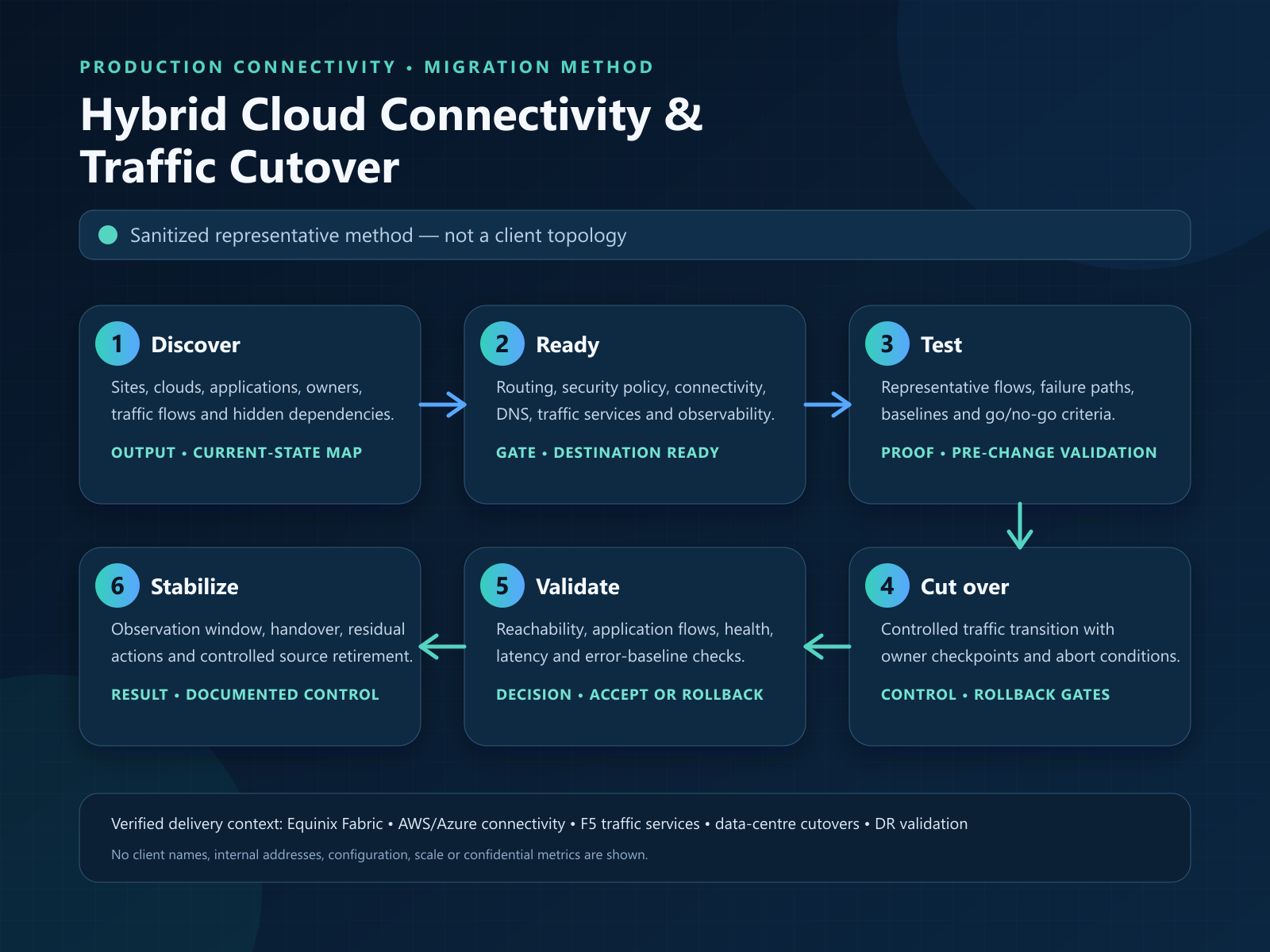
Hybrid Cloud Connectivity & Traffic Cutover Method
Sanitized representative method — not a client topology. No client names, internal addresses, configuration, scale or confidential metrics. Built from delivery experience with hybrid connectivity, Equinix Fabric, AWS, Azure and GCP connectivity, F5 traffic services, data-centre cutovers and DR validation.
Client work and a representative method
A client migration still running on infrastructure Afroz manages, the sanitized cutover method, and a client application in production.
OffpeakTraining.com
WordPress migration and managed hosting
Live client site, still running on infrastructure Afroz manages.
Open buildHybrid Cloud Connectivity & Traffic Cutover
Production connectivity and traffic-cutover method
Sanitized representative method, not a client topology — no client names, internal addresses, configuration, scale or confidential metrics.
See the methodExam Simulator — The PM Village
Flask / PostgreSQL application deployed in Docker on Ubuntu with Coolify
Public client project. Client feedback from the founder is shown below.
Open build
"I appreciate his ability to be a true partner in understanding my business requirements and translating the technical concepts to me in an approachable way."
View on GoogleThe Google review covers the exam-platform engagement and later website migration and hosting work. The displayed sentence is quoted exactly and is not presented as an endorsement of every service.
Three ways to engage
Start small and bounded, or bring the whole migration. Scope, price, cutover window and rollback criteria are agreed before work starts, and you always hear plainly if something is not a fit.
Assessment or diagnosis
Readiness assessment for a planned move, diagnosis of a failed migration or unstable deployment, or a review of a cutover plan someone else wrote.
- Fixed, bounded scope
- Findings, risks and dependencies written down
- Go / no-go recommendation and rollback options
- Useful on its own, whether or not Layer7 does the project
Scoped project
Discovery through stabilization using the six-stage method, with scope, price, cutover window and rollback criteria agreed before work starts.
- Discovery, readiness, testing, cutover, validation, stabilization
- Owner checkpoints and explicit abort conditions
- Works directly for the business, or behind a partner’s brand
- Clear handoff at the end
Managed care
Hosting or operations support, monitoring coordination, backups, updates, small improvements, and priority issue handling within an agreed scope. New projects are scoped separately.
- Available after delivery, not as a blanket retainer
- Backups, updates and monitoring coordination
- Small improvements and priority issue handling
- 10+ live WordPress sites currently hosted or maintained
After delivery, someone who already knows the environment
Managed care is available after a successful migration, recovery or deployment. It covers hosting or operations support, monitoring coordination, backups, updates, small improvements, and priority issue handling within an agreed scope.
It is offered where it fits rather than as a blanket retainer, and new projects are always scoped separately. Afroz has operated WordPress infrastructure for more than ten years and currently hosts or maintains more than ten live WordPress sites, including the client site migrated in the proof above.
Managed care is a senior engineer on an agreed scope, not a 24/7 operations centre. Response expectations are set per engagement, in writing.
What Layer7 will and will not promise
Easier to read now than to discover mid-cutover.
Layer7 will
- Map dependencies and write down what cannot break before the change
- Prepare and test the destination before traffic moves
- Agree go / no-go and rollback criteria with the owner in advance
- Cut over in a business-approved window with abort conditions
- Validate afterwards and stay through an observation window
Layer7 will not
- Guarantee zero downtime — nobody responsible can without understanding the environment
- Promise 24/7 emergency response or a fixed response-time SLA
- Commit to a completion date before discovery
- Quote performance, savings or availability numbers that have not been measured
- Publish confidential client environments, topology, configuration, scale or metrics
Migration and recovery questions
The practical questions that come up before a first call.
The workload and its owners, the dependencies (data, integrations, DNS, TLS, routing, firewall and load balancing), the state of the destination, backup and rollback access, and the checks that will prove the move worked. You get the findings, the risks, and a go / no-go recommendation, whether or not Layer7 does the migration.
Discovery of the site, plugins, database, integrations and DNS; a prepared destination (VPS or managed hosting) with backups and TLS in place; a test copy validated before any DNS change; a cutover window agreed with you; validation of the live site; and an observation window afterwards. Hosting and maintenance are available after that if you want them.
Then the work starts with readiness: confirming that DNS, TLS, routing, firewall rules, load balancing, monitoring, backups and ownership are genuinely in place, not just provisioned. Gaps found there are the usual reason a destination is “ready on paper” and fails in production.
Yes. Layer7 prepares the destination, handles the container and database dependencies, validates the environment before traffic arrives, and stays through cutover and stabilization. A production Flask/PostgreSQL application deployed in Docker on Ubuntu with Coolify is public proof of that path.
Rollback criteria, access and steps are written down before the cutover, and abort conditions are agreed with the owner. During the change there are checkpoints where the decision is explicitly “continue” or “roll back”. Validation after the change decides whether the source can be retired.
It depends on the workload: typically the source and destination hosting or cloud accounts, DNS, and the application repository or backups. Access is scoped to what the engagement needs, arranged after scope is agreed, and never requested through the contact form.
After a successful delivery: hosting or operations support, monitoring coordination, backups, updates, small improvements, and priority handling of issues within an agreed scope. It is offered where it fits, not as a universal retainer, and new projects are scoped separately.
Yes. Scheduled evening and weekend cutover windows are available by arrangement, agreed in advance as part of the plan. That is a scheduled window, not a 24/7 on-call service.
Not on this site for migration and recovery projects: every environment is different enough that a price without discovery would be a guess, so scope and price are agreed before work starts. Small fixed-scope starters — a readiness assessment, a staged WordPress migration with tested rollback, or an outage diagnosis — are available and priced on request, so the first step is easy to say yes to.
Yes — all of them, and the hybrid connectivity between them. Afroz’s background is production network and infrastructure engineering, so routing, security policy, DNS and load-balancer dependencies are treated as part of the migration rather than as an afterthought.
Validation first: reachability, application behaviour, health, logs, traffic, and the business checks agreed up front. Then an observation window for residual fixes, handoff of operational ownership, and controlled retirement of the source once it is safe.
Yes. Layer7 works remotely from Milton, Ontario with clients across Canada and the United States. Local meetings around Milton and Halton can be arranged when a project benefits from them.
Still have questions?
Discuss a migration or recoveryDiscuss the source, destination, deadline, and what cannot break.
A short brief is enough to start. Layer7 aims to reply within one business day with questions or a bounded first step — an assessment, a diagnosis, or a scoped plan.
Milton, Ontario · Serving Canada & the US
Contact Layer7